Sag zu Erkältung &
Gelenkschmerzen 
tschüss!
Filimia®

aus der Pflanze Mädesüß
Apotheke finden

Anwendungsgebiete

[1]  EMA/HMPC/434892/2010

[2] Farzaneh A, et al. Filipendula ulmaria (L.) Maxim. (meadowsweet): a review of traditional uses, phytochemistry and pharmacology. Res J Pharmacogn. 2022;9(3):85–106.

[3] Katanic J, et al., In vitro and in vivo assessment of meadowsweet (Filipendula ulmaria) as anti-inflammatory agent. J Ethnopharmacol. 2017;198(2):608–609

[4] Samardzic S, et al.,  Antihyperalgesic activity of Filipendula ulmaria (L.) Maxim. and Filipendula vulgaris Moench in a rat model of inflammation. J Ethnopharmacol. 2016;193(12):652–656

[5] Samardzic S, et al.,  Antioxidant, anti-inflammatory and gastroprotective activity of Filipendula ulmaria (L.) Maxim. and Filipendula vulgaris Moench. J Ethnopharmacol. 2018;213(3):132–137

[6] Blazics B, et al., LC-MS qualitative analysis and simultaneous determination of six Filipendula salicylates with two standards. Chromatographia. 2010; 71: 61–67.

[7] Sroka Z, et al., Phenolic extracts from meadowsweet and hawthorn flowers have antioxidative properties. Z Naturforsch. 2001;56(9–10):739–744.

[8] Proestos C, et al. Natural antioxidant constituents from selected aromatic plants and their antimicrobial activity. Food Technol Biotechnol. 2008;46(2):151–156.

[9] Csedo K, et al. The antibiotic activity of Filipendula ulmaria. Planta Med. 1993;59(S1):675.

[10] Boziaris IS, et al. Antimicrobial effect of Filipendula ulmaria plant extract against selected foodborne pathogenic and spoilage bacteria. Food Technol Biotechnol. 2011;49(2):263–270.

[11] Boziaris IS, et al. Acid-induced injury renders Salmonella enteritidis PT4 sensitive to the antimicrobial action of Filipendula ulmaria plant extract. Int J Food Sci Technol. 2012;47(8):1784–1787.

[12] Mitra SP. Pharmacology and biochemistry behind the use of natural herbs to control arthritis, a review. Indian J Nat Prod Resour. 2017; 8(3): 204–223.

[13] Matic S, et al., In vitro and in vivo assessment of the genotoxicity and antigenotoxicity of the Filipendula hexapetala and Filipendula ulmaria methanol extracts. J Ethnopharmacol. 2015; 174(11): 287–292.

[14] Harbourne N, et al., Optimisation of the aqueous extraction conditions of phenols from meadowsweet (Filipendula ulmaria L.) for incorporation into beverages. Food Chem. 2009; 116(3): 722–727.

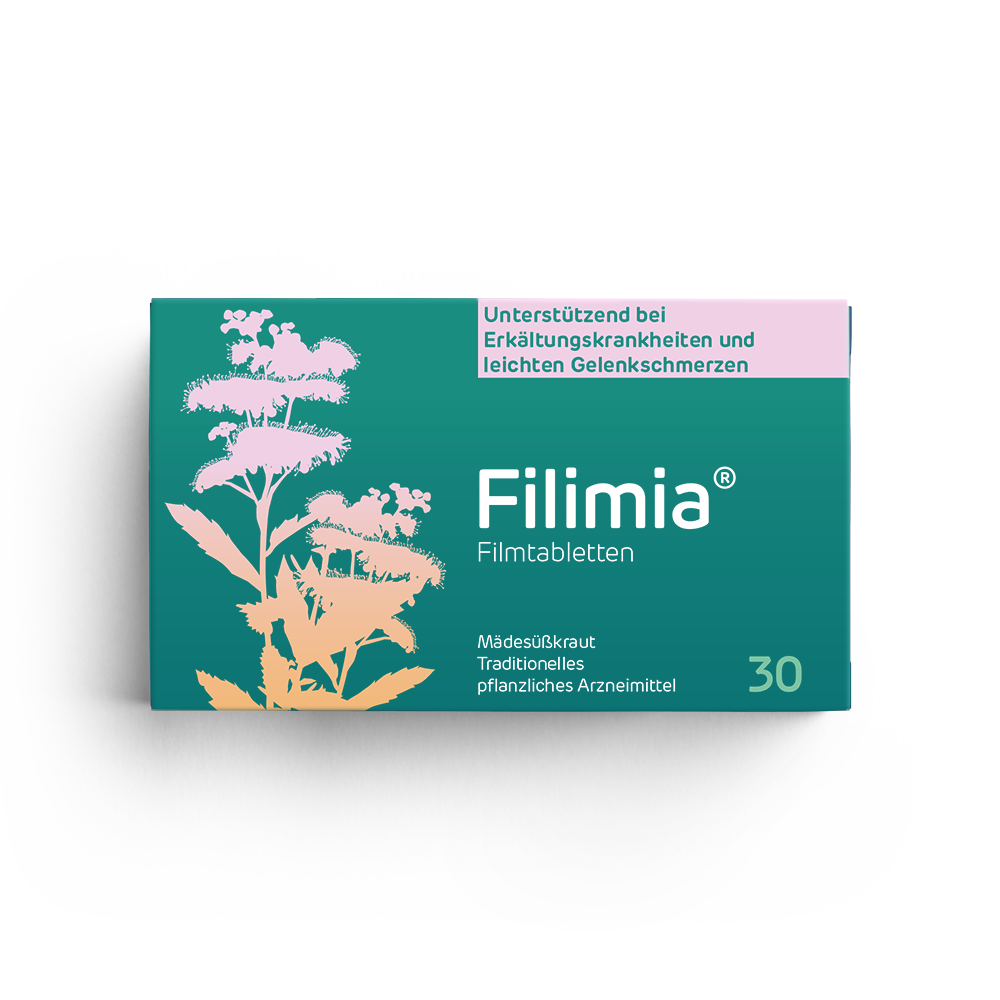
Was ist Filimia® 

Filimia® ist ein traditionelles pflanzliches Arzneimittel dessen Wirkstoff die oberirdischen Teile der Heilpflanze Mädesüß (Filipendulae ulmaria herba) beinhaltet.

Die Anwendung von Mädesüßkraut ist seit Jahrhunderten bekannt und wurde in vielen wissenschaftlichen Untersuchungen beschrieben. Die Europäische Arzneimittelagentur (EMA) bewertet seine traditionelle Anwendung bei Erkältungskrankheiten und leichten Gelenkschmerzen als sinnvoll und sicher.

Danke des jahrhundertealtem Wissens über Mädesüßkraut bietet Filimia® eine innovative, natürliche Behandlungsalternative bei diesen Beschwerden – gut verträglich und einfach anzuwenden.

Die traditionelle Anwendung von Mädesüßkraut zeigt bisher keine Nebenwirkungen oder Wechselwirkungen mit anderen Arzneimitteln1. Die Einnahme gilt somit als unbedenklich und sicher, auch in Kombination mit anderen Arzneimitteln.

1 EMA/HMPC/434892/2010

Wie wirkt Filimia®

Der Wirkstoff in Filimia® stammt aus dem Mädesüßkraut (Filipendula ulmaria herba). Diese Heilpflanze enthält eine Vielzahl natürlicher Pflanzenstoffe, die zu ihrer medizinischen Wirkung beitragen. Die Heilpflanze wurde bereits in vielen wissenschaftlichen Studien untersucht. Diese Untersuchungen haben gezeigt, dass sie

  • Schmerzen lindert,
  • Entzündungen hemmt und
  • dabei magenfreundlich bleibt. 2


Filimia® macht diese kraftvolle Heilpflanze in Form eines praxistauglichen Arzneimittels schnell verfügbar.

Farzaneh A, et al. Filipendula ulmaria (L.) Maxim. (meadowsweet): a review of traditional uses, phytochemistry and pharmacology. Res J Pharmacogn. 2022;9(3):85–106.

Filipendula ulmaria (L.) Maxim.

MÄDESÜSS- die Heilpflanze hinter Filimia®

Echtes Mädesüß (Filipendula ulmaria (L.) Maxim.), auch als Wiesenkönigin bekannt, ist eine in Europa heimische Heilpflanze. In Österreich ist das Echte Mädesüß landesweit verbreitet, besonders häufig in feuchten Wiesen, Flussauen und Mooren des Alpenvorlands und Donauraums.

Mädesüßkraut ist eine ausdauernde Pflanze. 

Die Pflanze ist leicht zu erkennen:

  • stabile, kantige Stängel
  • gefiederte, grün glänzende Blätter
  • zahlreiche cremeweiße Blüten in dichten, duftenden Blütenrispen
„Unsere Mission ist es, das Wissen der Pflanzenheilkunde mit moderner Forschung zu vereinen. Mit Filimia® bieten wir ein traditionell bewährtes pflanzliches Arzneimittel, das bei Erkältung und Gelenkschmerzen auf natürliche Weise wirkt.“
Dr.Stephan Niedan, Geschäftsführer ADler PHarma

Gebrauchs­­information

Filimia® Gebrauchsinformation

Über Wirkungen und mögliche unerwünschte Wirkungen informieren Gebrauchsinformation, Arzt oder Apotheker.  Rezeptfrei erhältlich in Ihrer Apotheke.